Last updated 1 July 2026
If you’re thinking about getting an electric vehicle through your employer, there’s one tax benefit that changes the numbers completely. The federal government’s FBT exemption on electric cars has been saving Australians thousands every year since 2022. But the rules are changing, and the window to get the best deal is closing.
Here’s what you need to know.
What is the FBT exemption?
Fringe Benefits Tax (FBT) is a 47% tax that employers normally pay when they provide a car to an employee. Under a standard novated lease for a petrol car, that FBT liability gets passed back to you. It adds up fast.
For eligible electric vehicles, that tax is currently zero. The government exempts battery electric vehicles and hydrogen fuel cell vehicles from FBT entirely, which is why an EV novated lease looks so different on paper compared to a conventional car lease.
On a $55,000 EV, the annual FBT that would otherwise apply is around $10,750. Gone.
How much can you actually save?
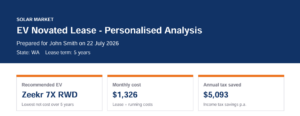
The FBT exemption is one part of why novated leasing an EV stacks up so well. Add the GST savings on the purchase price, the GST savings on running costs, and the income tax reduction from salary sacrificing, and the total saving over a five-year lease can reach $20,000–$25,000 compared to buying the same car privately.
On an $80,000 salary with a $55,000 EV, you’re typically looking at $7,000–$9,000 per year better off. Higher income earners save more. The 45% marginal tax rate makes every pre-tax dollar work harder.
Use our EV Novated Lease Calculator to run the numbers for your salary and the vehicle you’re considering.
Which vehicles qualify?
Not every EV is eligible. The ATO sets three conditions:
- The vehicle must be a Battery Electric Vehicle (BEV) or Hydrogen Fuel Cell Electric Vehicle (FCEV)
- It must have been first held or used on or after 1 July 2022
- Its GST-inclusive value must not have exceeded the LCT threshold for fuel-efficient vehicles at the time of first retail sale ($91,661 for 2026-27)
For a full list of current EV models that qualify and their prices, see our Which EVs Still Qualify for the FBT Exemption? guide.
PHEVs no longer qualify. They were removed from the exemption on 1 April 2025. If you’re considering a plug-in hybrid like the Toyota RAV4 PHEV or Mitsubishi Eclipse Cross PHEV, it won’t qualify under any new arrangement.
The changes coming — and why the next 10 months matter
On 5 May 2026, Treasurer Jim Chalmers and Energy Minister Chris Bowen announced the FBT exemption will be wound back in three stages.
Now to 31 March 2027: Nothing changes. The full exemption applies to all eligible EVs under the LCT threshold.
1 April 2027 to 31 March 2029: Full exemption continues only for EVs priced at $75,000 or less. EVs between $75,000 and $91,661 get a 25% FBT discount instead. Still useful, but noticeably less generous.
From 1 April 2029: All eligible EVs under the LCT threshold receive a 25% FBT discount. The full exemption ends.
One important point: if you’re already in a novated lease, your existing arrangement is not affected. You keep the current rules for the life of your lease. The same applies if you sign before 31 March 2027. Lock in a lease now and you hold the current rules for the full term.
Does this actually affect most buyers?
For the majority of EV buyers, the $75,000 price point in Phase 2 is not an issue. The most popular models on novated leases in Australia sit well under that — the BYD Atto 3, Tesla Model 3, MG4, and similar commuter EVs all come in comfortably below $75,000.
Where it matters is for higher-spec vehicles. A Tesla Model Y Long Range, a Polestar 3, anything pushing toward $85,000–$91,000. Buyers looking at that price range have a real reason to move before April 2027.
Is it still worth it after 2029?
Yes. A 25% FBT discount is less generous than a full exemption, but it still beats a fully taxed arrangement. The GST savings on purchase and running costs, plus the income tax reduction from salary sacrifice, stay in place regardless of FBT settings.
EVs are also significantly cheaper to run than petrol cars. At current fuel prices, most Australian drivers save $2,000–$3,000 a year on fuel alone when switching from petrol. That saving has nothing to do with FBT.
How to get started
Check with your HR or payroll team first. Most medium and large employers in Australia offer salary packaging, but you need employer approval to set up a novated lease.
Pick a vehicle under the current LCT threshold for fuel-efficient vehicles, get a drive-away quote from a dealer, and your novated lease provider structures the finance from there. Simple enough once you know what you’re looking for.
Want to see what you’d save? Try our EV Novated Lease Calculator and punch in your salary and the vehicle you’re considering.
For a full breakdown of all current EV incentives including state-based rebates, stamp duty exemptions and the import tariff waiver, head to our Australian EV Charger Rebates and Grants page.
This article is general information only and does not constitute financial or tax advice. The figures and examples used are illustrative. Before making any decisions about salary packaging, novated leasing or EV purchases, consult the ATO or a registered tax agent.
The federal government exempts eligible battery electric vehicles and hydrogen fuel cell vehicles from Fringe Benefits Tax (FBT) entirely when purchased through a novated lease. This means the full cost of the car and running expenses can come from pre-tax salary.
Battery Electric Vehicles (BEVs) and Hydrogen Fuel Cell Electric Vehicles (FCEVs) first held or used on or after 1 July 2022, with a GST-inclusive value not exceeding the LCT threshold for fuel-efficient vehicles ($91,661 for 2026-27). PHEVs no longer qualify from 1 April 2025.
The full exemption runs until 31 March 2027. From 1 April 2027, only EVs under $75,000 keep the full exemption. From 1 April 2029, all eligible EVs receive a 25% FBT discount instead.
No. Existing leases are not affected. If you sign before 31 March 2027, you keep the current rules for the full term of your lease.
On an $80,000 salary with a $55,000 EV, you’re typically $7,000–$9,000 per year better off. Total savings over a five-year lease can reach $20,000–$25,000 compared to buying privately.