Last updated 16 July 2026
Getting an EV charger installed at home is one of the first things most new EV owners organise. It’s a straightforward process when you know what to expect, but costs and requirements vary more than most people realise. A few decisions up front can save money and hassle later.
Do You Need a New Charger?
Most EVs come with a portable Level 1 cable that plugs into a standard 10-amp household outlet. This works, but it’s slow: around 10–20km of range per hour. For most drivers, a dedicated Level 2 wall-mounted charger is worth installing. It delivers 40–130km of range per hour and gives you a full charge overnight.
For a full explanation of charger types, visit our Electric Vehicle Chargers page.
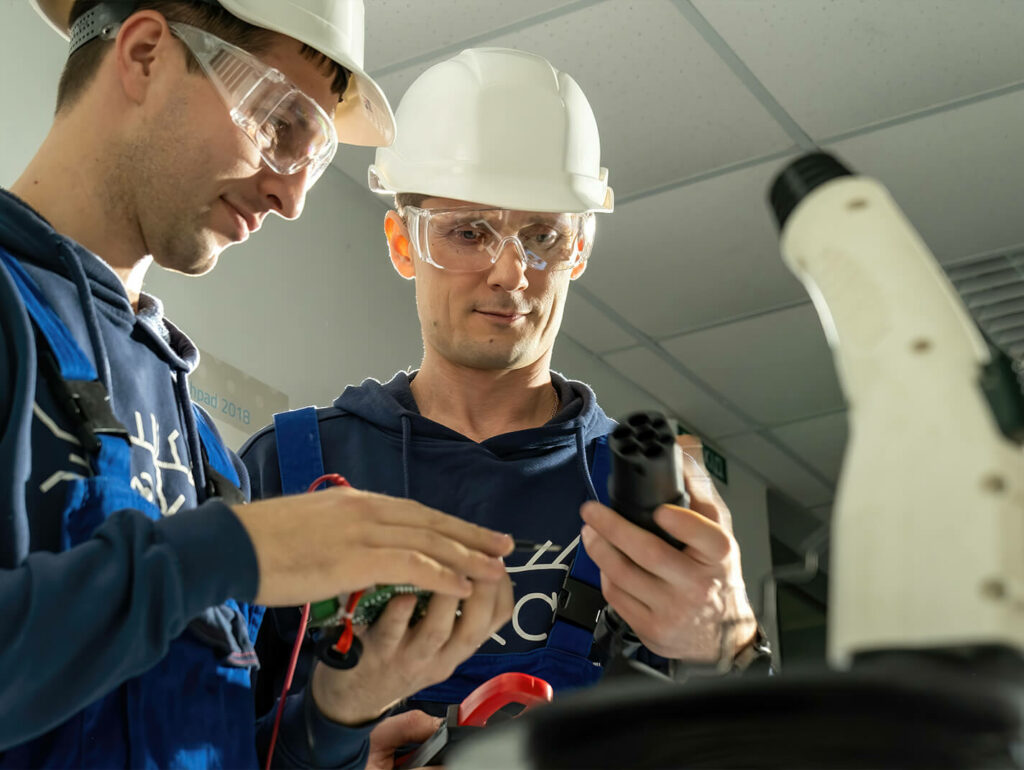
A licensed electrician will assess your switchboard and cable run before providing a quote.
What Does Installation Involve?
A Level 2 charger requires a dedicated circuit run from your switchboard to the charger location. The work must be carried out by a licensed electrician. It’s a legal requirement in Australia and essential for your home insurance to remain valid. On completion, your electrician must issue a Certificate of Compliance for Electrical Work (CCEW).
A standard installation on a modern switchboard with a straightforward cable run typically takes half a day. More complex jobs, such as long cable runs, outdoor installations, or switchboard upgrades, can take a full day or require two visits.
What Does It Cost?
Installation costs vary depending on your home’s setup. Here’s a realistic breakdown for 2026:
Standard installation on a modern switchboard with a cable run under 15m: $300–$600 for labour, plus $750–$1,800 for the charger hardware. Total typically $1,200–$2,200.
If your switchboard needs upgrading, which is common in homes built before the 1990s with ceramic fuse boards, add $800–$2,500 for the switchboard work. Total can reach $3,500–$4,500.
Three-phase installations for faster 11kW or 22kW chargers typically cost $2,500–$4,500 all-in, depending on whether your home already has three-phase supply.
The biggest variable is the cable run. Every extra metre between your switchboard and the charger location adds cost, particularly if it involves running cable through walls, under paving, or along external surfaces.
What to Check Before Getting Quotes
A few things worth knowing before you call an installer:
Your switchboard age. Homes built before the mid-1990s often have older fuse boards that need upgrading before a Level 2 charger can be safely connected. Your electrician will assess this during the quote.
Single-phase or three-phase power. Most Australian homes run on single-phase, which supports chargers up to 7.4kW. Three-phase opens up faster 11kW or 22kW options. Check your vehicle’s maximum AC charge rate first though, since many EVs can’t accept more than 7.4kW regardless of the charger.
Cable run distance. Where you want the charger matters. A garage wall next to the switchboard is the simplest and cheapest scenario. A carport at the far end of a long driveway is a different job entirely.
Outdoor vs indoor. Outdoor installations require a weatherproof charger rated at least IP65. In coastal areas, look for IP66.
Finding a Qualified Installer
All EV charger installations in Australia must be completed by a licensed electrician. When getting quotes, check that your installer:
- Holds a current electrical contractor licence in your state
- Has experience with EV charger installations specifically
- Will provide a Certificate of Compliance for Electrical Work on completion
Solar Market can connect you with qualified, experienced installers in your area. Get 2 free quotes and compare.
Rebates and Incentives
Some state governments offer rebates towards home EV charger installation costs. Visit our Australian EV Charger Rebates and Grants page for the current picture by state.
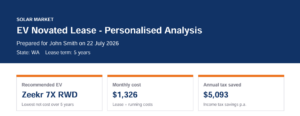
If you’re purchasing your EV through salary packaging, the FBT exemption can reduce the overall cost of the vehicle. Try our EV Novated Lease Calculator to see what you could save.
Get 2 Free Quotes Today
Solar Market connects you with qualified EV charger installers across Australia. Tell us what you need and we’ll get you 2 free quotes to compare.


 Step 3